latest from the stream

essays, working notes, fragments, mixtapes, podcasts, and experiments

Golden wheat field stretching towards a tree-lined horizon under a pale cloudy sky
Soulcruzer

The Horizon

I’m standing in a field looking towards the horizon. It occurs to me that I’ve spent a lifetime doing this. Different fields. Different coastlines. Different countries. Different versions of myself, always finding a line where earth gives itself over to sky. The horizon is a peculiar thing. It promises distance while refusing arrival. However far you walk, it quietly withdraws, asking nothing except that you keep going. For reasons I can’t quite explain, the Oracle from The Matrix wanders into the field with me. Not the whole scene. Just one line. “I thought you’d have figured that out by now.“

Read More »
Soulcruzer

The Door, the Black Hole, and the Trace: Notes on Obscurity

(1) The door opens I keep thinking about a passage I read recently: “Leave the door open for the unknown, the door into the dark. That’s where the most important things come from, where you yourself came from, and where you will go.” I like the mystery of it. The unknown is a black hole, a dragon, a grey man living a grey life. It whispers: “You’ll die in obscurity. You’ll leave no trace that you ever existed. You have won no awards. You’ve made no impact. You’re gone tomorrow just like that.” I hang onto the idea that people

Read More »
Soulcruzer

What the Street Was Certain Of

The morning began with a quiet decision to let the town rearrange itself around me.1 I had spent the weekend building two small dérive apps. Nothing polished, just enough to nudge my attention sideways. And now, standing at the edge of Leamington Spa, I wanted to see what they would do to a place I thought I knew. Twenty-six years of walking these streets had given me a practical map: the shortcuts, the shops I relied on, the routes that got me from one thing to the next without fuss. But the apps didn’t care about any of that. They

Read More »

working notes

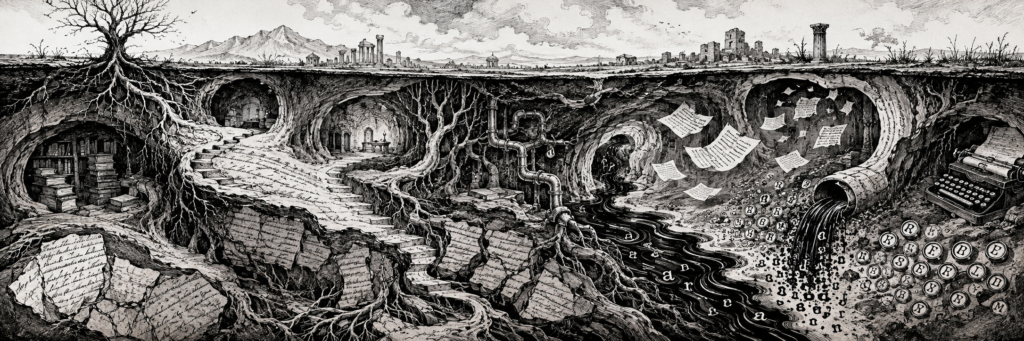
Fragments, field notes, and half-lit thoughts from the textual underground 

It feels to me as though this is the only true choice we have.

You did not ask to be born. You did not choose your parents. You did not choose the circumstances into which you arrived. The only real choice, I think, lies in deciding how we will play the hand we have been dealt.

Not to mix metaphors, but I am reminded of Thomas Henry Huxley’s description of life as a game of chess.

He was searching for a metaphor for the silent player seated opposite us from the moment we are born:

“The chess-board is the world, the pieces are the phenomena of the universe, the rules of the game are what we call the laws of Nature. The player on the other side is hidden from us. We know that his play is always fair, just, and patient. But also we know, to our cost, that he never overlooks a mistake, or makes the smallest allowance for ignorance.”

It is important to remember that the hidden player is not malicious.

It simply follows rules that do not bend for our comfort. Its only demand is that we learn the board or accept the consequences of failing to do so.

We learn the moves because we must.

Perhaps that is where freedom begins: not in choosing the game, the board, or the pieces we were given, but in learning how to play them.

I’ve been thinking about the difference between critical thinking and the kind of intelligence that has to sit beside it.

Critical thinking gets a lot of the limelight. Fair enough. It is the part of the mind that asks for evidence, spots the loose plank in an argument, and refuses to be charmed by every shiny claim that comes down the road. In a culture thick with sales pitches, outrage machines, and synthetic certainty, we need it. It is the Yang move: active, discriminating, separating what holds up from what does not.

But I keep wondering what its Yin counterpart is.

My best name for it, today, is receptive thinking. It is not the same as switching your brain off. It is not believing everything you feel, or treating a hunch as a court ruling. It is the capacity to sit with something before you pull it apart. To listen before you judge. To notice tone, context, relationship, body language, the strange image that arrives while you are making coffee, and the fact that an idea may still be half-grown.

Critical thought asks: is this true? Receptive thought asks: what is this showing me?

One works by distinction. The other works by attunement. One tests the map. The other notices what the map has left out: the texture of the ground, the person standing beside you, the nagging feeling that the question itself has been framed too narrowly.

I recognise the Yang reflex in myself. It wants to get hold of a thought quickly, put it through its paces, and decide whether it deserves to stay. Useful reflex. It has saved many of us from bad arguments, dodgy gurus, and the kind of certainty that falls apart the moment you ask it a second question.

Yet an overworked critical faculty can become a little border guard behind the eyes. Every new thought has to produce a passport before it can enter. Some ideas need questioning; some need a little room. A walk. A notebook. A few days of being carried around in the body before language catches up.

The opposite trap is real too. Receptivity without discernment can turn into absorption, where every feeling becomes a fact and every coincidence becomes an instruction. That road can get very strange, very quickly.

So I am not looking for a winner. I am looking for a rhythm. Receive the signal. Let it form. Then test it. Put it into words. See what remains when it meets other people, actual life, and the awkward furniture of reality.

Maybe thinking well is less like holding court and more like a good conversation between two old friends. One says, “Hang on, does that really stand up?” The other says, “Yes, but have you properly listened yet?”

An Olympus Tough compact camera held over dry grass

Dusting off the old street photography and field note cameras this morning. The first one out of the drawer is my old Olympus Tough: compact, waterproof, shockproof, and made for being carried rather than protected.

I’m about to head into Leamington Spa to give the Deríve app I made over the weekend its first proper outing. The plan is simple: follow its prompts, pay attention to where they take me, and let the camera collect a few traces along the way

deríve app

I don’t know what I’m looking for yet. That’s part of the point. A camera like this feels less like equipment and more like permission to wander with my eyes open.

Sometimes the old tools don’t need replacing. They need a walk.

The mistake is to build the gift shop first.

A lot of independent people do this. We make the course, the membership, the coaching offer, the template pack, and the shop. Then we stand in the doorway wondering why nobody has come in.

It’s the wrong end of the building.

The work itself is the museum. The blog, the walk, the field note, the odd little web page, the newsletter, the experiment, the short video made from a day outside: these are the rooms people wander through. They’re where someone gets a feel for how you see, what you notice, the questions you keep returning to, and whether there’s a real person behind the thing.

A useful offer can still sit at the end of that visit. It might be a course, a workshop, a book, a paid community, a print, a small tool, or a way to go deeper. But it works best as something a person takes home from territory they have already spent time in. A souvenir, if you like, but one with a job to do.

This is not an argument against making money from the work. It’s an argument for letting the work have a life before asking it to become a funnel. Build rooms. Leave doors open. Let people see the practice in motion.

The same thing applies to AI. The tools now let one person make far more than they could make alone: pages, drafts, videos, apps, images, research trails, even small strange artefacts. That doesn’t make the human unnecessary. It makes taste, attention, and editorial judgment more valuable. Somebody still has to decide what is worth making, what belongs together, what sounds true, and what can go in the bin.

I’m trying to think of the solo practice less as a personal brand and more as a small studio. The writer, researcher, editor, designer, and technician may now have some machine help. Fine. Somebody still has to walk the road, notice the bird on the fence, have the thought, and decide why it matters.

Make the museum. The gift shop will have something worth selling.

I keep coming back to this: people are looking for something genuine.

They might call it good work, a useful tool, a decent conversation, a song that gets under the ribs, a place where they can take their guard down for five minutes. The label changes. The hunger doesn’t

You can feel the difference when somebody has tried to make contact rather than merely perform. There’s a person in the thing. A bit of risk. A lived question. Maybe a rough edge left in because polishing it away would have taken the life out of it.

Genuine does not mean perfect, pure, or terribly serious. It means the thing comes from somewhere real. It has fingerprints on it. It gives you a reason to believe there might still be somebody on the other side of the screen.

Thinking with my feet

I have started calling them Wisdom Walks, which sounds a little grand for what usually begins with me putting on my shoes and trying to get out of the house before I disappear too far into the screen.

But the name has earned its keep. I go walking when something in me has become stuck: a question about work, a snag in a piece of writing, a feeling I have been carrying round without properly looking at it. I don’t go out with a plan to solve it. I take it with me and see what happens once it has to travel alongside the rest of life.

There’s a difference between sitting at a desk and trying to think your way through a problem and walking with it for an hour. At the desk, I can become a small committee meeting in my own head. I revisit the same argument, polish the same worry, and call it inquiry. On the road, the question has to make room for traffic, dogs, the weight of my rucksack, somebody mowing a lawn, and the stiffness in my legs on a hill. The world keeps interrupting. I think that is part of the point.

Walking puts a question back into proportion. It gets it out of the little sealed room behind my eyes. It does not make the question disappear, but it lets me come alongside it rather than stare at it from six inches away.

Some of my favourite philosophers were keen walkers. Thoreau made walking a way of refusing the narrowness of town life and other people’s expectations. Rousseau used his walks for memory, solitude, and self-examination. Nietzsche claimed that all truly great thoughts are conceived while walking. I do not need to borrow their coats to see the truth in it. A thought changes when the body has to carry it.

That is the bit I keep coming back to. I think better on the move because movement is not just the backdrop to the thinking. It is part of the apparatus. The rhythm of the feet, the changing ground, the simple fact of having somewhere to go: all of it gives the mind another way to work. Ideas arrive sideways. An old memory turns up because I pass a particular street. A sentence I could not finish at the desk finds its last few words when I am crossing the road.

Not every walk gives me a revelation. Some walks leave me with tired feet and less static in my head. That is enough. I do not want to turn walking into another self-improvement project with targets and outcomes. Sometimes the walk is simply a way of letting the mind compost. Sometimes it gives me a line for the notebook. Sometimes it shows me that I have been asking the wrong question.

For me, a Wisdom Walk is self-inquiry with the doors open. I take a question out into the world, let the road and the body have their say, and wait to see if a truer sentence catches up with me.

I write from the crossroads of philosophy, myth, music, AI, learning, and ordinary life. This is my living archive: part field notebook, part essay chamber, part signal fire from the textual underground, part hypertext adventure.

Working Notes from the Textual Underground

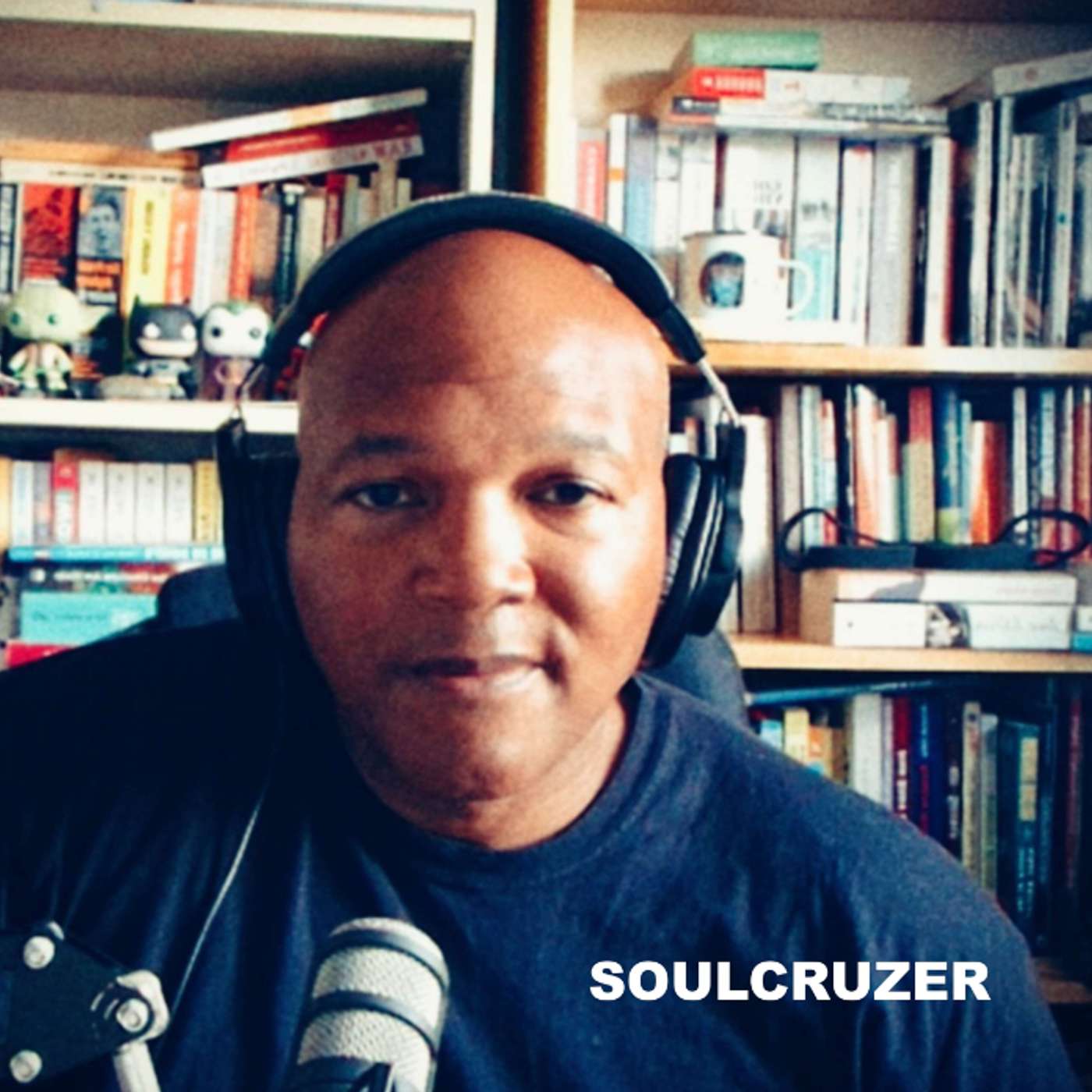
Hi, my name is Clay Lowe, aka Soulcruzer. This is the part where I have to reduce myself to a label so you can understand who I am and what I am about. But as Kierkegaard pointed out, labels have a way of negating the person. If I tell you I’m a blogger, I get reduced to whatever meaning you’ve assigned to the word ‘blogger’. It has been my habit to resist labels. And yet, here we are. So, in the context you find me in now, I am indeed a blogger, and I am much more than that!

I have worn many other labels. I’ve been an infantry officer, a learning and development consultant, a trainer, and a coach. I’ve also called myself a barefoot philosopher, a narrative alchemist, and a rogue learner, among others things. These were an attempt to orient me to myself and myself to you. More recently, I’ve been working out what it means to operate as a text-based ontologist in a world where text is becoming the universal substrate.

A text-based ontologist sounds like someone who should live in a footnote.

They don’t.

They live in the browser window, the notebook, the prompt box, the blog editor, the Obsidian graph, the half-finished post, and the walking thought captured before it evaporates. Their material is language. Their subject is being. Their method is to hold attention long enough for a sentence to disclose what it is carrying.

It’s not really a job title. It’s more of a way of relating to this blog and the wider web.

In the end, though, I’m just a dude doing his thing and sharing it on the internet. 

The best place to follow my work is here. Better yet, get the newsletter version and never miss a post, or alternatively, subscribe via my RSS feed.

latest from the podcast

status update

BlueSky Latest Posts

last check-in

Avonvale Veterinary Centres, Warwick, United Kingdom, UTC+1

I do like to chat. Say hi!

0
Would love your thoughts, please comment.x
()
x